

Will Cleaning The Spring Help A Fan Clutch
Inside your computer is a lot of sophisticated hardware — your CPU, graphics bill of fare, power supply, and more. These all generate a ton of heat. And the sensitive electric components inside your PC are vulnerable to high temperatures. To keep heat levels down, the fans within your reckoner starting time spinning to push the hot air out and absurd down your PC.
When putting your reckoner through intensive tasks — such as while playing online video games, editing large multimedia files, or performing a CPU stress examination — it'due south normal to have loud computer fans. So long as they calm downward when you're done, this isn't necessarily something to worry about. But if yous're experiencing lots of desktop or laptop fan racket nether normal circumstances, read on to see what the trouble might be.
Why is my computer fan running so much?
Your computer fan might be running in overdrive for a few reasons:
-
Your fans are muddied. Grit builds up within your computer, especially if you lot've got a bulky desktop PC. As dust collects on your figurer fans, they no longer piece of work finer. Dust and other debris are a common cause of noisy computer fans.
-
Your estimator can't ventilate heat. The discussion "laptop" is misleading — when you identify it on your actual lap, your legs both transmit heat to your laptop and also prevent cool air from cycling in to cool information technology down. Desktop PCs also need admission to cool air.
-
Your fans aren't working properly. Moving parts wear downward over fourth dimension and somewhen break. Desktop and laptop fans that are running loud might be loose. At that place might besides exist something wrong with the firmware for the hardware component running the wonky fan.
-
Your CPU is working also hard. Sometimes, information technology'southward non a fan problem at all. If there's a program eating up way more than its fair share of your CPU's resources, that can easily cause your reckoner to heat upwardly fast. A computer fan making noise out of nowhere can bespeak a high CPU usage issue.
Is it bad if my computer fan is loud?
Loud computer fans and loud laptop fans can bespeak bug, peculiarly if the noise persists for a long menstruation of time. A computer fan's chore is to keep your computer absurd, and excessive fan noise ways they're working harder than they unremarkably need to.
If your fans can't sufficiently reduce the heat levels inside your computer, you may start to feel a range of bug. Your CPU will self-regulate its operation to try and lower heat output, meaning that you lot'll see a noticeable driblet in speed and performance.
When your PC'south internal temperatures become also high, your CPU will shut itself down to avert permanent damage. That'due south why your computer crashes and gives you the notorious blueish screen of death. You might besides experience bug while starting upwardly your computer, such as a black startup screen or an endless series of reboots.
How tin can I make my reckoner fan quieter?
At that place are several ways to address desktop or laptop fan noise to tranquility your computer.
Each of the post-obit tips should assistance clean up and boost your reckoner'southward operation considerably. Attempt them in club — if i doesn't work, move onto the side by side.
1. Make sure cool air can accomplish your calculator
Before we get to your computer's internals, make sure you lot've placed your estimator in a location that helps information technology cool down.
Identify your desktop (or laptop) reckoner on a smooth, apartment surface, such as a desk or even the floor. Don't put it on a carpeted surface, and don't keep it inside a drawer or chiffonier — yous want absurd air to be able to broadcast around your computer. You demand to give the hot air inside your PC somewhere to go as your fans spin to remove it.
 Two laptops sitting on a smooth glass surface.
The same principle applies to your laptop. Utilise a laptop on a desk or a tabular array, and if you must put it on your lap, try and limit the time it sits there. You can besides utilize a laptop cooling platform, which should have a built-in fan to accident cool air up toward your laptop. Cooling pads as well let you lot use your laptop on your lap without worrying well-nigh overheating. Only don't leave your laptop out in the sun for likewise long, because that will brand information technology heat upwardly fast!
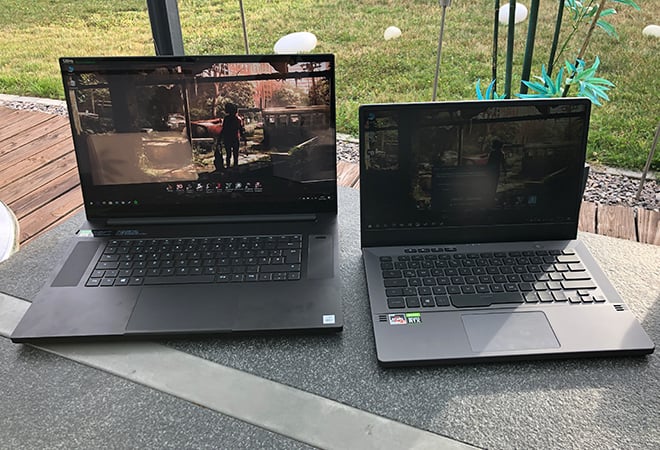 Two laptops placed on a table exterior.
Your laptop or PC casing should have little rubber "feet" on the bottom, which permit for a fleck of space between the casing and the surface your PC is sitting on. That gap is essential for allowing your calculator to dissipate rut, so if the anxiety have worn down or fallen off, replace them.
ii. Make clean your fans and vents
A loud calculator fan is often a dusty computer fan. As dust builds up, it prevents the fans from cooling your computer'south sensitive internal components as effectively as they should. Regularly remove grit from the fans and vents to let your reckoner to cool itself efficiently.
Earlier cleaning your computer, plow it off and unplug all cables and connections, especially the power cable.
Pick up a compressed air duster — also known every bit canned air — and spray it toward your computer's vents at an angle. Your goal is to blow the dust away, and not dorsum inside your computer'due south housing.
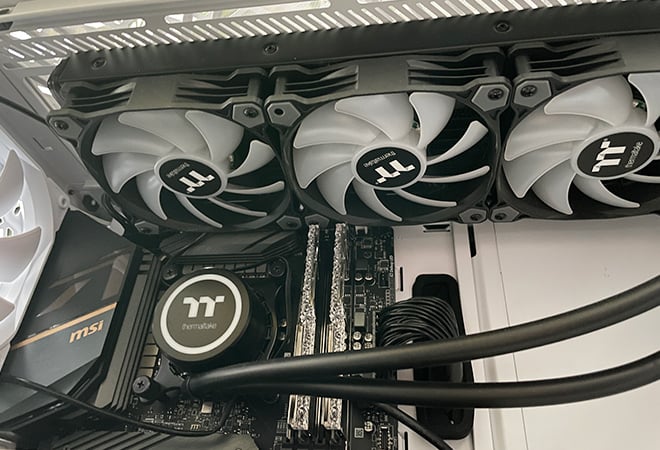 Cooling fans and other hardware inside a PC instance.
If you tin can, open up your computer to directly clean your CPU fan. If you lot have a desktop, you may find other fans inside as well, such equally for your RAM or GPU. To remove any dust build-upwardly, spray the fans in brusque bursts with your canned air, so wipe downwards the fans with a microfiber cloth to terminate the job. If your desktop figurer has a grit filter inside, clean this out as well.
While y'all're at it, clean your power supply fan with the same combo of compressed air and a microfiber fabric. Ability supply fans also get loud if they're too dusty to work properly. Exercise not open up your power supply, but clean it as best yous tin from the exterior.
Finally, audit the thermal paste on your CPU and whatever other units that have some. Thermal paste helps your CPU and GPU transfer heat to their oestrus sinks, and this paste can wear down over time, becoming less effective. If you notice whatever aging or worn down thermal paste, replace it.
Before closing up your reckoner, double-bank check that yous've plugged all your fans dorsum into the motherboard — otherwise, they won't piece of work at all.
3. Check that your fans are working properly (or supersede them)
Now that your calculator fans are nice and clean, put everything back together and turn on your estimator. You're looking to see whether the fans start up and spin normally. If and then, so y'all've done a keen task — just be certain to monitor your CPU and GPU temperatures for a while to make sure everything'due south working usually.
Only, if your reckoner fans are still making noise, or if they don't piece of work at all, it may exist time to replace them. Bank check and confirm your fans' dimensions before ordering new ones, or else you may be stuck with shiny new fans that don't fit within your PC.
While yous can replace virtually fans individually, if your power supply fan doesn't work, replace the unabridged power supply unit of measurement. Neat open up the power supply can exist unsafe. Too, an overheating power supply may exist unable to sufficiently ability all the components in your estimator. So rather than replace the fan, upgrade to a more powerful power supply instead.
How to keep your computer from getting then hot
Your fans tin just do so much to manage your computer's heat levels. If your desktop or laptop fans are even so running loud after yous've cleaned them, they may only be overworked. Software issues may also be responsible for making your computer fans and so loud — either something'due south non working as it should, or your hardware isn't powerful enough to run the software you're using.
Older and less-powerful computers may struggle to keep upwardly with modern video games — such every bit GTA V, Nighttime Souls, and Ark: Survival Evolved — as well as other complex applications, similar multimedia editing software. Meanwhile, many types of malware can overstress your CPU.
A dedicated performance optimization tool will ensure that your computer's resource are properly allocated at all times. AVG TuneUp will identify and deactivate unneeded programs so that you don't waste CPU ability on software you lot're not using.
AVG TuneUp volition also go on your difficult drive make clean and tidy by removing junk files, temporary data, unwanted bloatware, and other pointless files. An efficient computer is a cool computer, and a cool reckoner is a quiet calculator.
Check Job Manager for resources-hungry programs
Job Director will show you lot which programs are using which of your computer'south resources, and how much. It's an piece of cake mode to identify resource-hogging apps that might be overheating your reckoner and causing all that desktop or laptop fan noise.
Afterwards you identify the programs responsible for hogging your CPU and deejay space, you lot tin uninstall or update them as needed.
-
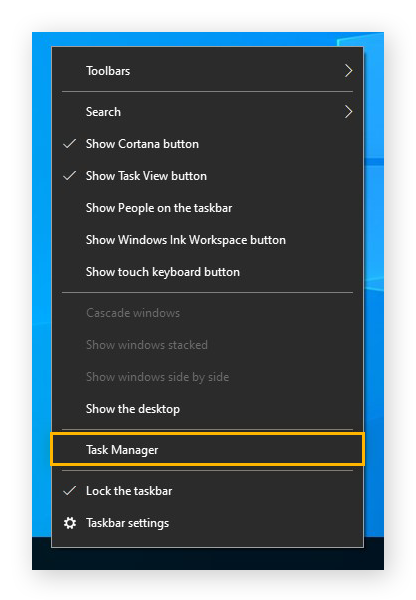
Right-click your taskbar and select Task Managing director.
-
Click the CPU tab to sort all active processes by the percentage of your CPU they're consuming. This will place the most resources-demanding programs right at the top.
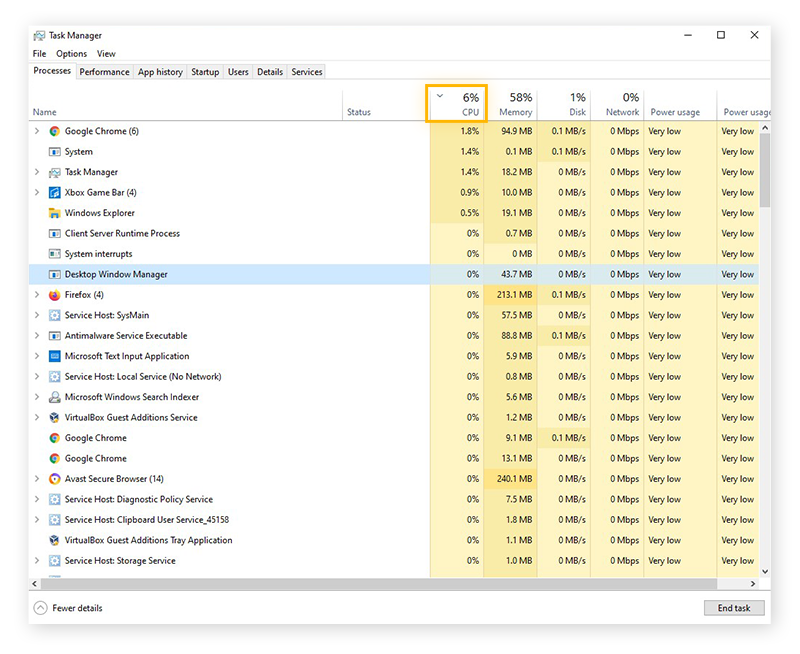
Information technology's normal to see some programs taking upward big amounts of your CPU for a split second or two. But if you notice sure programs consistently sitting at the top and consuming double-digit CPU resources, make a notation and conduct further research.
Updating or reinstalling the troublesome program might assistance calm things down and reduce your fan noise. This peculiarly applies to your graphics driver. If your GPU fan is making a lot of racket, update your drivers and see if the fans quiet downward.
AVG Commuter Updater makes updating your drivers incredibly piece of cake by scanning your reckoner and automatically updating any outdated or malfunctioning drivers.
-
Switch to the Disk tab. This volition prove you which programs are taking upward the near storage space.
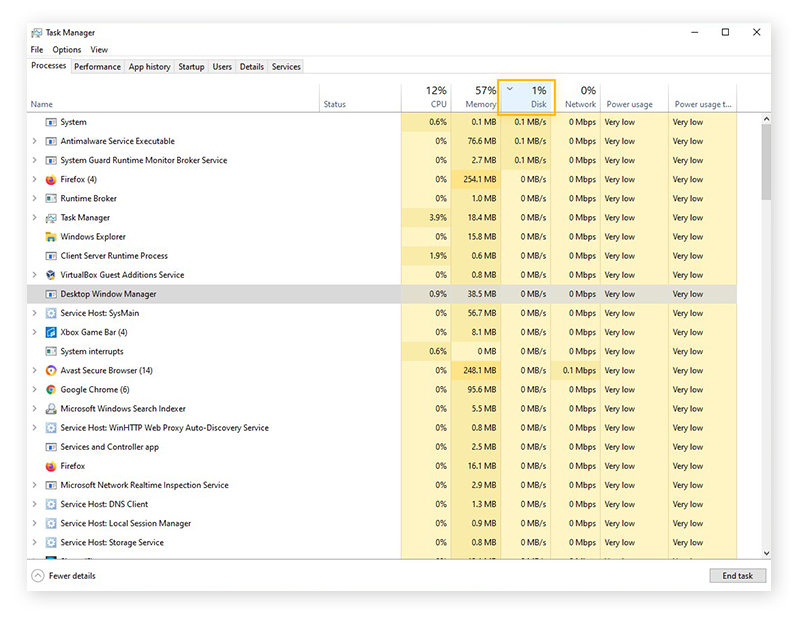
Having your computer sit at 100% disk usage is a common cause of loud fan noise and other performance issues. Disk usage problems can often be resolved by updating Windows, removing malware, disabling the Windows Superfetch service, or clearing out junk files with a performance optimizer like AVG TuneUp.
If you're seeing consistently loftier deejay usage, run the CHKDSK system tool to diagnose any difficult drive errors.
Remove and prevent malware infections
Many types of malware eat up big portions of your computer'due south resources and storage. Viruses and worms will hog both as they replicate and shop copies of themselves in your figurer. Adware will chew through CPU usage equally information technology showers y'all in pop-up ads, while cryptominers — malicious programs or browser scripts that forcefulness your computer to mine cryptocurrencies for a hacker's benefit — tin can crusade serious overheating problems.
A malware detection and removal tool from a reputable provider is your strongest ally in the fight against resource-hogging malware. AVG AntiVirus Complimentary automatically scans, detects, and removes all types of malware, while too keeping y'all protected against future infections.
Without malware gobbling upwardly your CPU power and disk space, your fans will take a much easier job.
Optimize your computer's functioning with AVG TuneUp
AVG TuneUp is a specialized performance booster that ensures your estimator always uses its resources as efficiently every bit possible. Here's how to use it to sharpen your figurer's performance. First download and install AVG TuneUp.
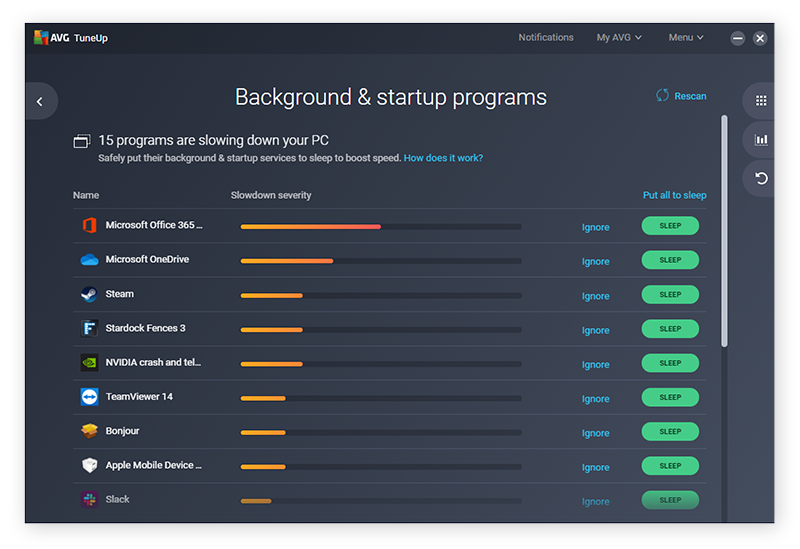
Use Sleep Mode to deactivate unneeded programs
AVG TuneUp's patented Sleep Mode feature detects programs that chew through arrangement resources by running in the background when y'all don't need them. It'll hibernate these programs, and and then wake them back upwards every bit soon as y'all need to use them again.
That saves CPU power and RAM for what you lot really need and helps proceed your CPU temperatures downwards, which, in turn, makes your computer fan'south task a whole lot easier.
Automatically clean out junk files
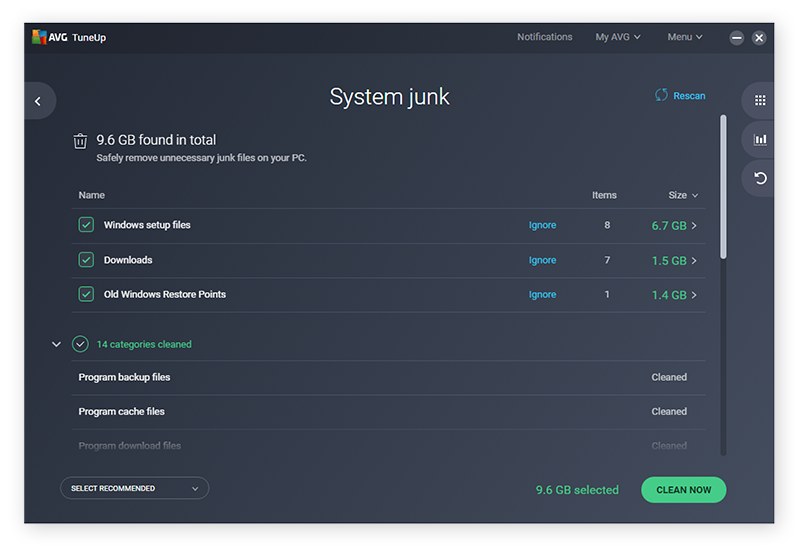
Windows is constantly creating temporary files in your arrangement as it works. If left alone, these junk files can have up a lot of space on your drive. Deleting this junk may fix those nasty 100% disk usage alerts and can assistance reduce the strain on your estimator fans.
AVG TuneUp'south Deejay Cleaner removes all sorts of junk files — not only temporary files, but also crash reports, cache files, thumbnails, unneeded install files, "recently used files" lists, and more.
Get rid of bloatware and other unwanted programs
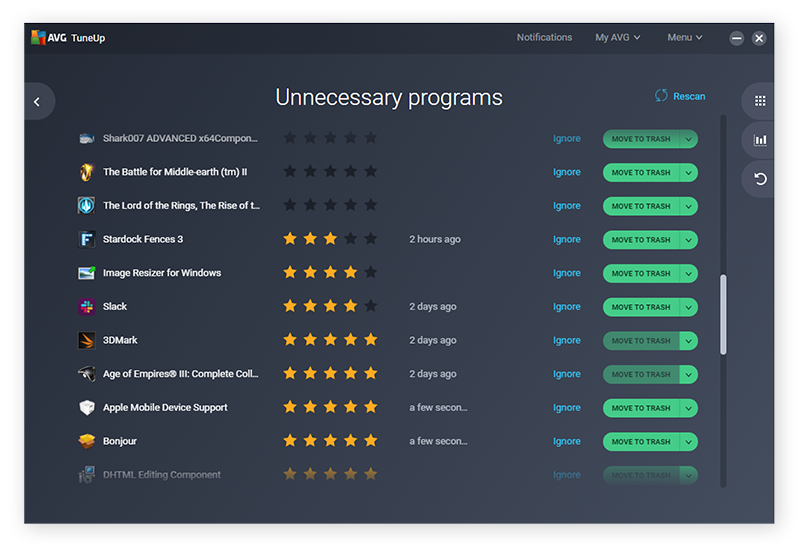
Bloatware refers to programs yous don't desire or need, but are on your reckoner anyhow. These programs and other like software can crusade fan problems for two reasons: they can suck upwards valuable CPU processing ability and occupy precious difficult drive infinite.
A shortage of CPU power or storage space can force your computer to work harder than it usually should, which means — you guessed it — loud fan dissonance. Yous tin can easily remove these apps from your estimator with AVG TuneUp'south bloatware removal tool.
Optimize your PC's functioning with AVG TuneUp
If yous're overwhelming your computer with too many resource-hungry programs and loads of junk files, information technology's no wonder your fans are loud and going haywire. AVG TuneUp is a comprehensive PC optimization suite with an array of tools particularly designed to boost your reckoner'due south performance.
AVG TuneUp will remove all the junk files, bloatware, and other unneeded data that'south preventing your computer from performing at its best. And the built-in Sleep Style volition identify resources-hungry apps and send them into hibernation until you really need them. With a more efficient PC, your computer fans will be much happier — and quieter.

Source: https://www.avg.com/en/signal/fix-loud-computer-fan
Posted by: devinneyspeorne1972.blogspot.com
0 Response to "Will Cleaning The Spring Help A Fan Clutch"
Post a Comment